In this article
What to check first on any C2 Corvette for saleC2 Corvette production and how to tell the years apartWhat the VIN tells you on a C2 CorvetteC2 Corvette engines by yearWhat "matching numbers" means on a C2 CorvetteWhat we found in 34 C2 Corvettes for sale on RareCars.comRestomods and replacement engines: when they make senseA pre-purchase checklist for a C2 Corvette for saleC2 Corvettes for sale on RareCars.comFAQSourcesTEAM-COPY-RULES self-check (not for publishing)Open itemsSearch for a C2 Corvette for sale and you'll find split-window coupes, factory fuel-injected cars, 427 big-blocks, LS-swapped restomods and plenty in between, sometimes at similar prices. The second-generation Corvette, the Sting Ray, was built for only five model years, 1963 through 1967, all at the St. Louis plant (sources 1 and 4). Each year looks a little different, the engine list changed every year, and the VIN won't tell you which engine a car left the factory with.
This guide covers how to tell the years apart, what the VIN can and can't prove, what "matching numbers" really means on a C2, and what we found when we read every 1963–67 Corvette for sale on RareCars.com, including live asking prices. If you'd rather start with the cars, browse every Chevrolet Corvette for sale on RareCars.com.
What to check first on any C2 Corvette for sale
Start with four questions, in this order:
- Which year and body is it? The VIN shows the model year and whether the car left St. Louis as a coupe or a convertible (sources 4, 5 and 6).
- What engine did it leave the factory with? That comes from the engine pad stamping and paperwork, not the VIN (sources 7 and 8).
- Is the engine the original one? That's what "matching numbers" means, and it's a separate question from whether the engine is the correct type (sources 7 and 8).
- Is it a restoration, a survivor or a restomod? All three are honest buys. They're just different purchases, and the listing should say which one it is.
C2 Corvette production and how to tell the years apart
Chevrolet built about 118,000 C2 Corvettes across five years (sources 1 and 5):
| Year | Convertibles | Coupes | Total |
|---|---|---|---|
| 1963 | 10,919 | 10,594 | 21,513 |
| 1964 | 13,925 | 8,304 | 22,229 |
| 1965 | 15,378 | 8,186 | 23,564 |
| 1966 | 17,762 | 9,958 | 27,720 |
| 1967 | 14,436 | 8,504 | 22,940 |
Some sources list the 1965 total as 23,562. Corvette Action Center notes a March 1991 correction to 23,564 (source 5).
Hagerty's spotter's guide (source 2) gives the quickest visual tells:
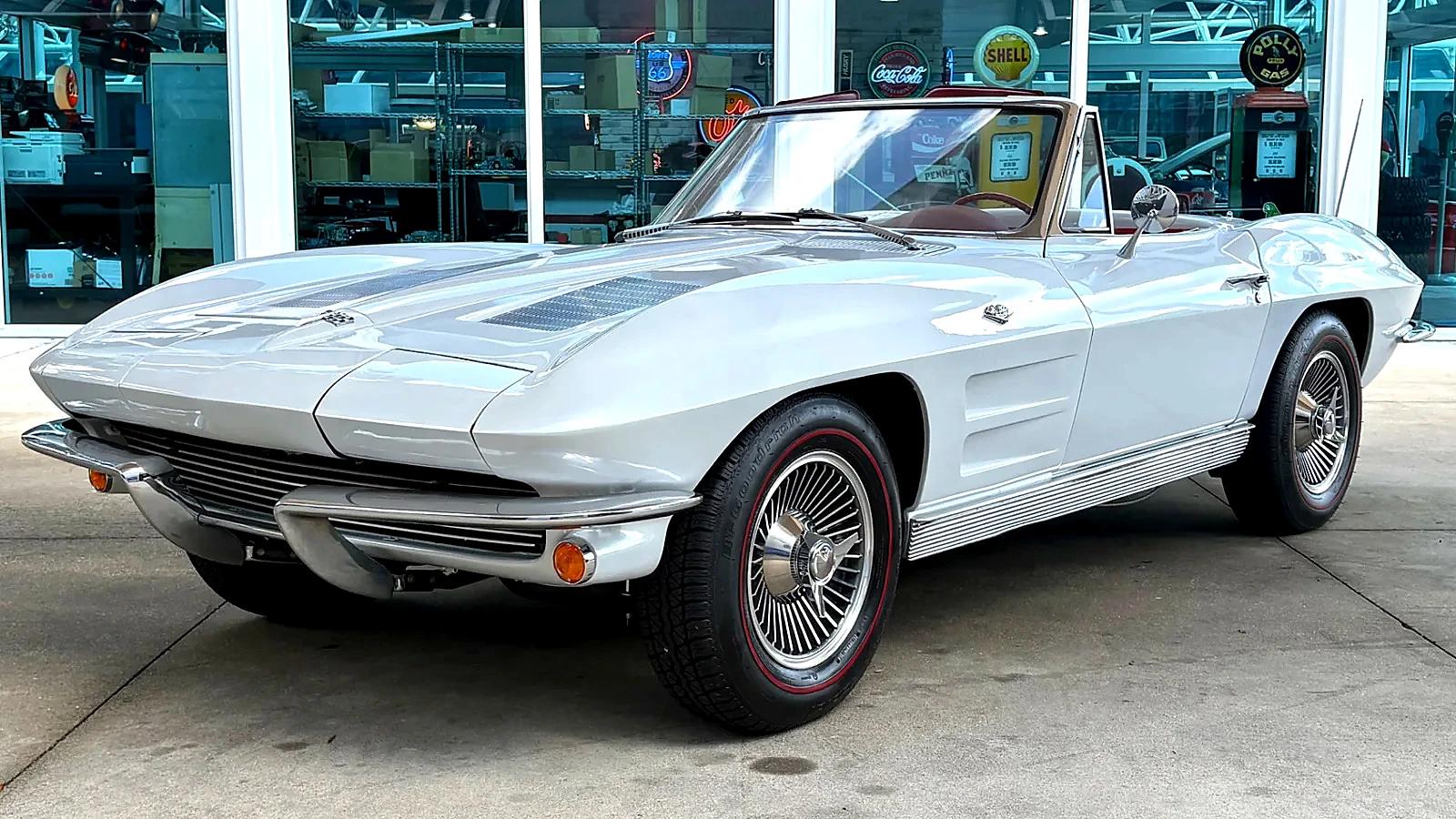
- 1963: the split rear window, on coupes only. A 1963 convertible has no split window, so look for the hood trim that imitates twin grilles and the twin horizontal recesses behind the front wheels.
- 1964: a one-piece rear window. The hood keeps the indentations but loses the trim, and the fender recesses carry over.
- 1965: three vertical fender "gills" and a new hood. A "396" fender badge means 1965, the only year that engine was offered.
- 1966: coupes lose the C-pillar vents, and the emblems change. A "427" badge rules out 1965.
- 1967: five fender vents and a single backup light high in the center of the tail panel, both 1967-only. The "stinger" hood came on 427 cars in 1967, but it's a popular upgrade, so you'll often see it on earlier cars.
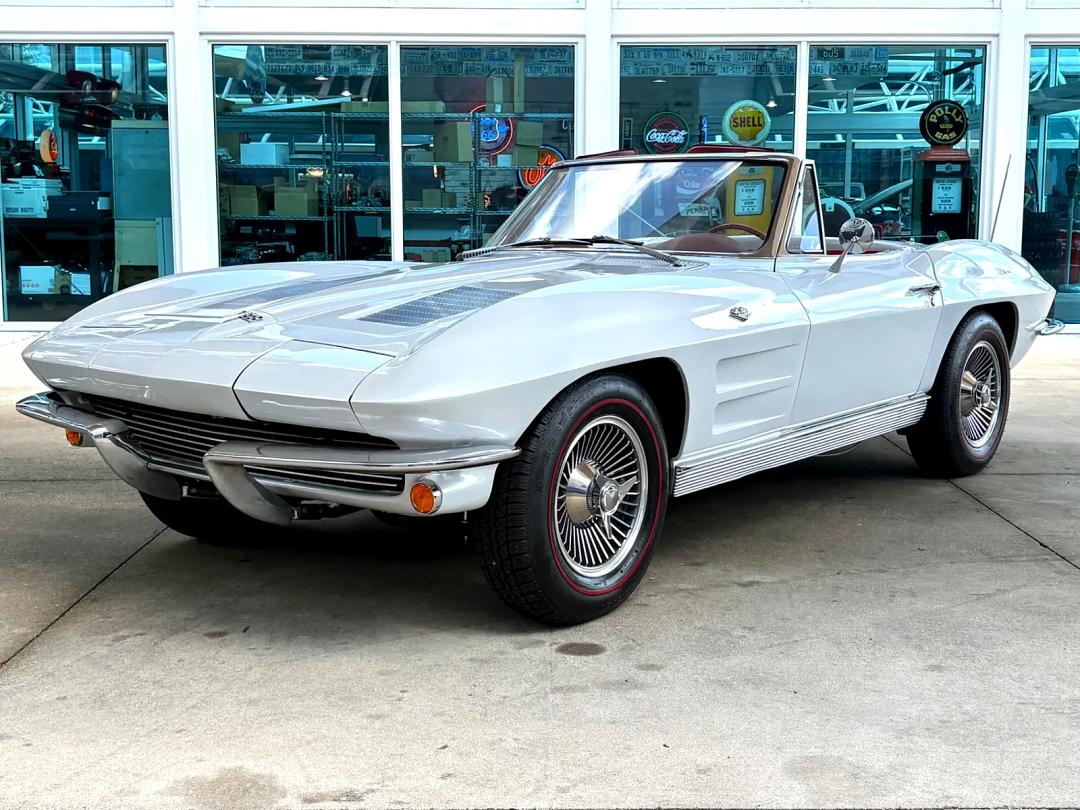
A 1963 Sting Ray convertible with a 327 and a 4-speed. Its VIN begins 30867, a 1963 convertible. Asking price $86,197 (as of Oct 28, 2026).
What the VIN tells you on a C2 Corvette
Chevrolet changed the VIN format for 1965 (sources 4, 5 and 6):
| Years | Example from a RareCars.com listing | How to read it |
|---|---|---|
| 1963–1964 | 3 08 67 S 113087 | 3 = 1963 (4 = 1964), 08 = Corvette, 67 = convertible (37 = coupe), S = St. Louis, then the 6-digit sequence starting at 100001 |
| 1965–1967 | 1 9 4 37 7 S 111980 | 1 = Chevrolet, 9 = Corvette, 4 = V8, 37 = coupe (67 = convertible), 7 = 1967 (5 = 1965, 6 = 1966), S = St. Louis, then the sequence |
Three things follow from that:
- The sequence has a ceiling. It starts at 100001 each year and can't run past that year's production, so a 1963 sequence above 121513 or a 1967 sequence above 122940 doesn't fit (source 6).
- The body code settles coupe vs. convertible. That matters for the 1963 split-window coupe, the most famous one-year feature of the C2. A 1963 coupe VIN reads 30837.
- The VIN doesn't record the engine or gearbox. Before 1972, you can't tell a Corvette's engine from its VIN. The engine pad suffix does that job (source 8). On 1965–67 cars, the "4" means only that it's a V8. So if any description says the VIN "confirms" a 327 or a 4-speed, read that as a claim to check against the engine stamp and the paperwork.
The VIN plate sits under the glove box (source 4), and the trim tag is nearby. The trim tag shows body build date, body style, paint and interior, but not the engine, drivetrain or options (source 7).
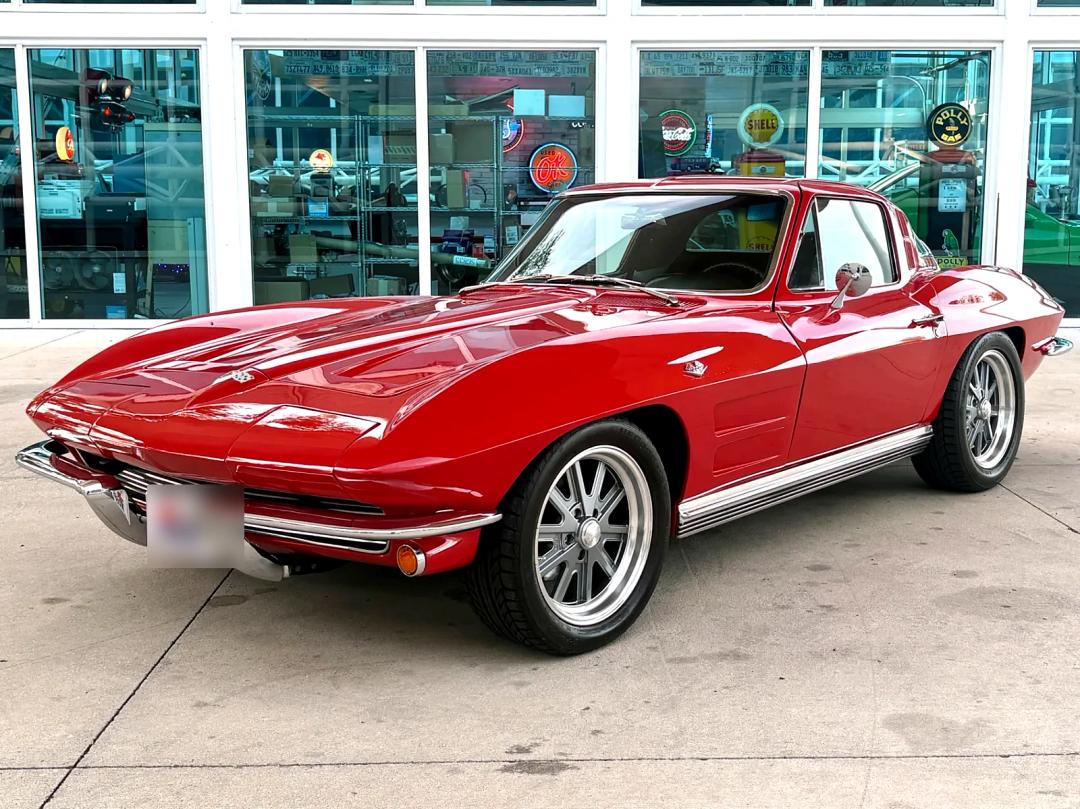
A 1964 coupe (VIN 40837…) with the one-piece rear window that replaced the split window, built as a restomod with a 327/300 and upgraded suspension. Asking price $79,997 (as of Oct 28, 2026).
C2 Corvette engines by year
The engine list changed every year, which makes a claimed engine easy to sanity-check (sources 1, 2 and 3):
| Year | Small-block 327 ratings (hp) | Fuel injection | Big-block |
|---|---|---|---|
| 1963 | 250, 300, 340 | 360 hp | None |
| 1964 | 250, 300, 365 | 375 hp | None |
| 1965 | 250, 300, 350 (L79), 365 | 375 hp (771 built, the last fuel-injected Corvette until 1982) | 396 / 425 hp (1965 only) |
| 1966 | 300, 350 (L79) | None | 427 / 390 and 425 hp |
| 1967 | 300, 350 (L79) | None | 427 / 390, 400 (three two-barrels), 435, and the L88 (20 built) |
What that means when you read a listing:
- A "1966 327/365" or a "1967 fuelie" didn't come from the factory that way. In 1966–67 the 327 was offered only at 300 or 350 hp, and fuel injection ended after 1965.
- A 1963 or 1964 with a 427 has a later engine. Big-blocks arrived in 1965.
- A 1967 "L88" needs serious proof. Only 20 were sold. A car with an L88-specification engine built later can be a terrific car, but it's a different car from one of the 20, and good listings say so.
- Disc brakes were standard from 1965. Only 316 of the 1965 cars got the drum-brake credit option (source 1).
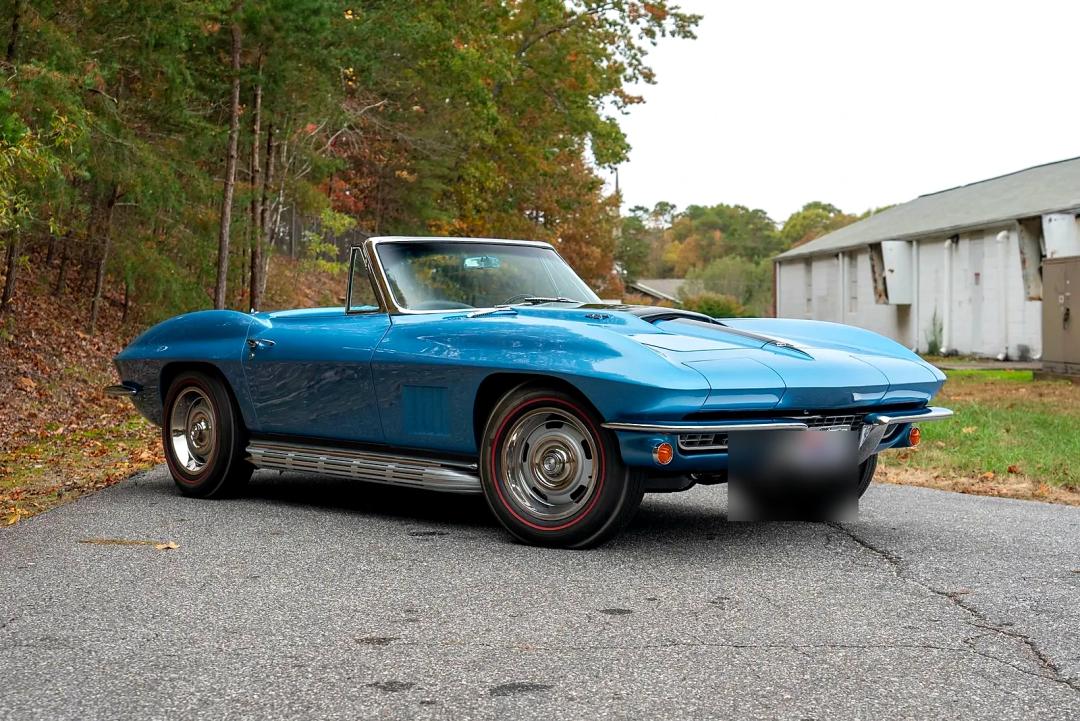
A 1967 convertible whose listing says plainly that its L88-spec 427 is a replacement engine installed during a later restoration. That's the kind of disclosure a buyer wants. Asking price $253,995 (as of Oct 28, 2026).
What "matching numbers" means on a C2 Corvette
"Matching numbers" is the phrase you'll see most in C2 listings and the one that needs the most care. Specialist references agree it means more than having the right engine type (sources 7 and 8):
- The engine pad. On the machined pad at the front of the block, passenger side, ahead of the cylinder head, an original C2 engine carries two stampings. One is the assembly code, for example F0118RC: F for the Flint plant, 01 for January, 18 for the day, and RC for the application suffix. The other is a partial VIN (source 7).
- The suffix shows what the engine was built to be. The partial VIN shows whether that engine was assigned to this car. You need both (source 7).
- The dates must run in order. Block casting date, then engine assembly date, then the car's build date. A block cast after the car was built isn't the original (source 7).
- "Numbers-correct" isn't "matching." A correct-type replacement engine with the right suffix and dates is numbers-correct, not matching (source 8).
| Evidence | What it proves | What it can't prove |
|---|---|---|
| VIN | Model year, body style, plant, sequence | Engine, transmission or options |
| Trim tag | Body build date, body style, paint, interior | Engine, drivetrain or options |
| Engine suffix | What the engine was built for | That it was installed in this car |
| Partial VIN on the engine pad | That the engine was assigned to this car | That the stamping hasn't been altered |
| Factory paperwork | Original options and configuration | Condition or later changes |
Table summarized from source 7.
The paperwork that helps most
- Protect-O-Plate. Chevrolet used them from 1965 for warranty records. They list engine, transmission and axle codes, and they were often lost with the owner's manual (source 9).
- Tank sticker (1967). The build sheet was attached to the top of the fuel tank. It's the most sought-after document because it covers the whole drivetrain and the options. Convincing forged tank stickers exist, so have an expert look at one (source 9).
- Judging results. An NCRS Top Flight award means the car scored 94% or more of 4,500 points in a deduction-based judging of originality and condition, judged against how the car left the factory (source 10). The NCRS judging manuals and the Bloomington Gold process are the main authorities for cars of this era (source 8). Ask for the score sheets and the date, because a car can change after it's judged.
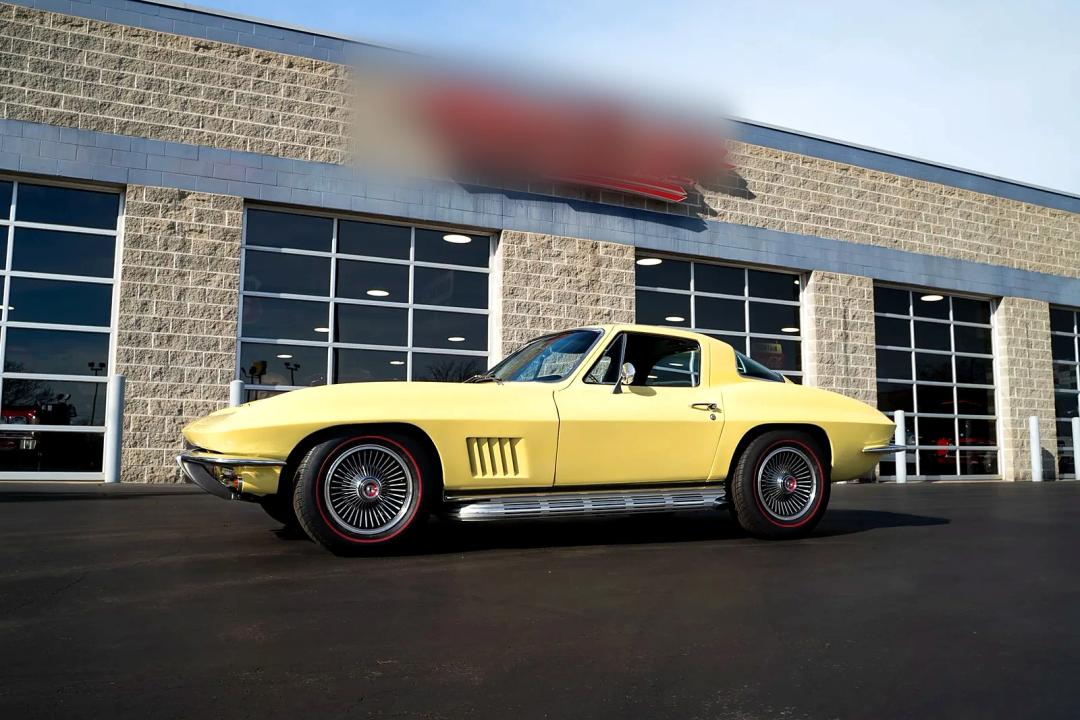
A 1967 L79 coupe listed with a numbers-matching 327/350 and 4-speed, and offered with its original tank sticker, Protect-O-Plate and owner's manual. Asking price $89,995 (as of Oct 28, 2026).
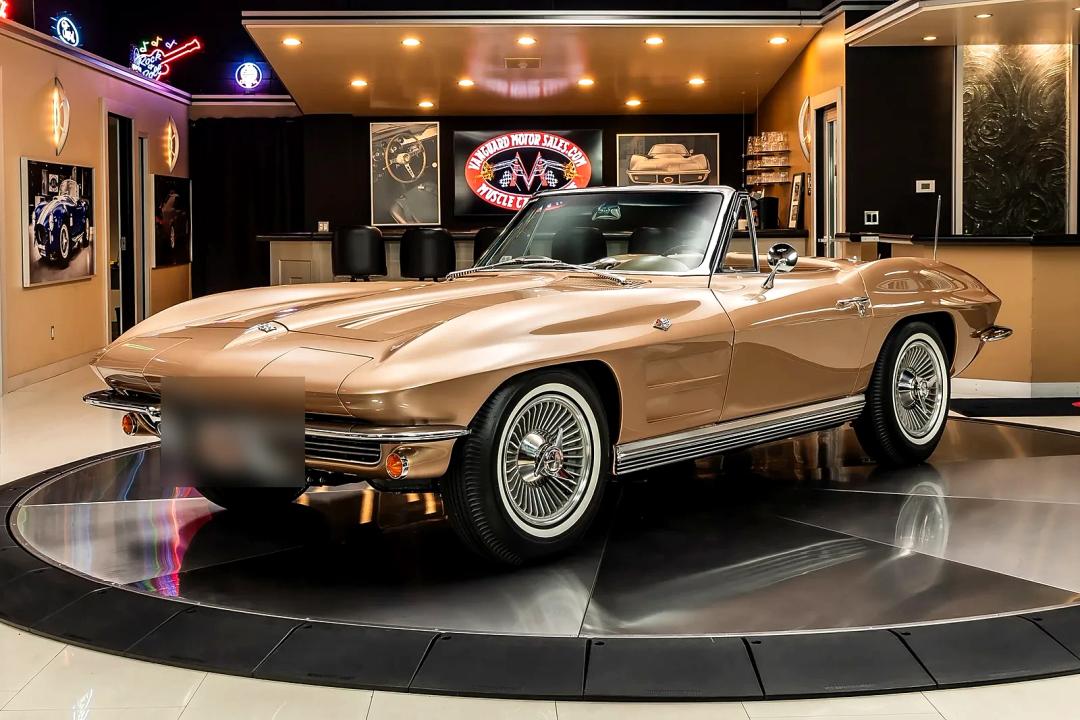
A 1964 convertible listed as an NCRS Top Flight car with a numbers-matching 327/300, 4-speed and both tops. Asking price $169,900 (as of Oct 28, 2026).
What we found in 34 C2 Corvettes for sale on RareCars.com
On Oct 28, 2026, RareCars.com had 34 Corvettes from 1963 to 1967 live (every one returned a live page with 20 photos). Of those, 30 show an asking price and 4 don't. Live asking prices on the 30 priced cars ranged from $39,995 to $339,995, and half asked less than about $90,000. Here's what the listings show:
- Every year is covered. 6 cars are 1963s, 7 are 1964s, 5 are 1965s, 8 are 1966s and 8 are 1967s.
- Convertibles dominate. By VIN body code, 26 are convertibles and 7 are coupes. The last car's VIN as shown is too short to decode, and its listing calls it a roadster.
- There's no split-window coupe listed right now. All six 1963s are convertibles (VIN body code 67). That fits how rare the split window is: it was a one-year, coupe-only feature.
- 10 listings say the engine is numbers-matching. One more 1965 fuel-injected car comes with its matching drivetrain on a stand, with a newer engine installed.
- 3 mention a judging result or certification: two NCRS Top Flight awards (one dated 1999 in its listing) and one Bloomington Gold Survivor. One more is offered with its original tank sticker and Protect-O-Plate.
- About a third are built rather than restored. 6 run a modern engine (five LS-family V8s and one 632-cubic-inch big-block), and at least 6 more say they have a replacement engine of a traditional type.
- The stinger hood travels. At least 5 listings describe a stinger-style or big-block hood on a car that doesn't claim a factory big-block, exactly as the spotter's guide warns.
- Manual gearboxes rule. 32 of the 34 are listed with a manual transmission.
None of this is a judgment about any particular car. It's a guide to which questions to ask.
Restomods and replacement engines: when they make sense
A C2 restomod keeps the Sting Ray body and swaps in a modern engine, gearbox, brakes and suspension, sometimes on a new chassis. It makes sense if you want to drive the car often and don't need factory originality. For a restomod the questions change:
- Who built it, and are there build records and a parts list?
- What chassis and suspension is it on, and what was done to the original frame?
- Does the title VIN match the VIN plate on the car?
A traditional replacement engine, such as a later 327 or a period-type 427, is just as honest when it's disclosed. Price it as what it is, not as a matching-numbers car.
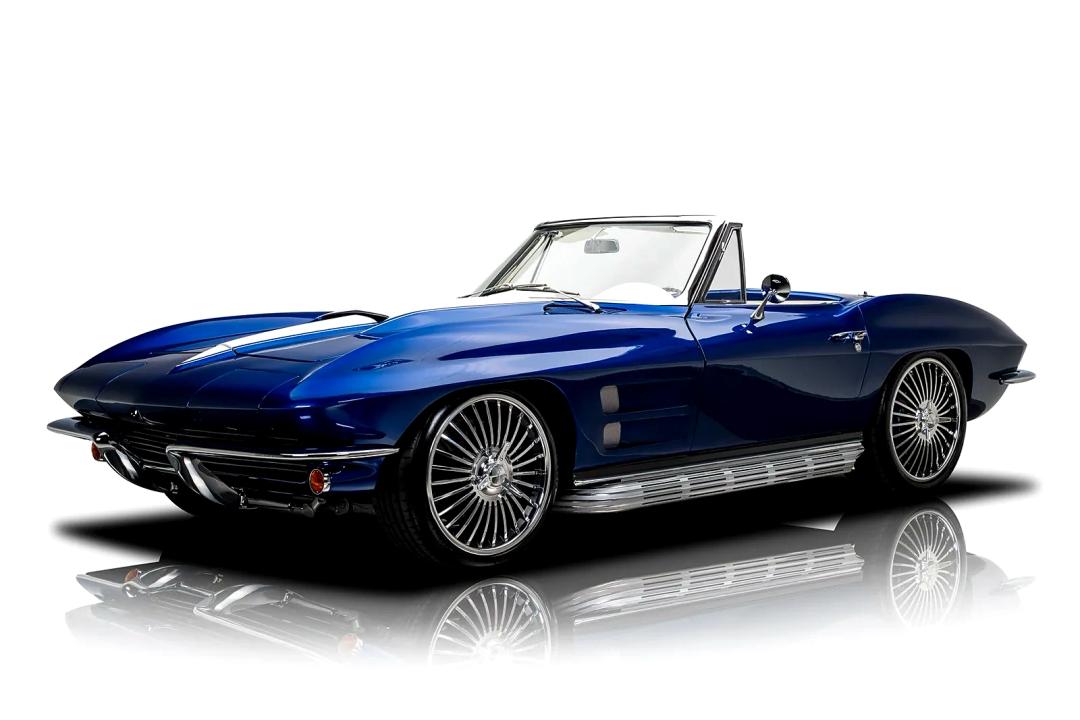
A 1964 convertible restomod with a 6.2-liter LS3 V8, a 6-speed manual and an aftermarket chassis with modern independent suspension. Asking price $269,900 (as of Oct 28, 2026).
A pre-purchase checklist for a C2 Corvette for sale
- Decode the VIN: year, coupe (37) or convertible (67), St. Louis (S), and a sequence that fits the year's production.
- Make sure the title VIN matches the plate under the glove box.
- Check the year's visual cues (gills, vents, hood, backup light) against the VIN year.
- Check the claimed engine against what Chevrolet offered that year (see the engine table).
- Look at the engine pad: assembly code, suffix and partial VIN. Ask the seller to photograph it.
- Ask for paperwork: Protect-O-Plate (1965–67), tank sticker (1967), window sticker or dealer invoice, plus judging sheets if the car has an award.
- Inspect the steel "birdcage" around the cabin for rust, especially at the base of the windshield. Hagerty also warns about poor collision repair (source 3).
- Look for fiberglass stress cracks and poorly patched panels along the bonding strips (source 3).
- Get an independent inspection by a midyear Corvette specialist before you pay.
C2 Corvettes for sale on RareCars.com
As of Oct 28, 2026, RareCars.com has 34 C2 Corvettes (1963–67) listed by dealers across the US. They range from a 1963 convertible restored mechanically to judged, numbers-matching cars and LS-powered restomods. Live asking prices on the 30 cars with listed prices run from $39,995 to $339,995 (4 listings show no price). Every listing is reviewed and approved, and you contact the listing dealer through RareCars.com to check availability. Cars sell, so if a car linked here is gone, see the Corvettes for sale now.
More to explore:
1. All Chevrolet Corvettes for sale, from 1950s C1s to modern cars
2. Corvette C2 listings
3. C1 Corvettes for sale, the generation before the Sting Ray
4. All Chevrolets on RareCars.com
5. Chevrolet Chevelles for sale and Pontiac GTOs for sale, the muscle cars of the same years
6. Classic car dealers near you
7. Selling a Corvette? List it on RareCars.com
8. Rare American cars of the 1960s
9. Porsche 993 production numbers, our guide to verifying a rare air-cooled 911
FAQ
What years are C2 Corvettes?
1963 through 1967. All were built at the St. Louis plant and sold as the Corvette Sting Ray (sources 1 and 4).
Which C2 Corvette has the split rear window?
Only the 1963 coupe. The 1964 coupe got a one-piece rear window, and convertibles never had it (source 2).
How many C2 Corvettes were built?
About 118,000: 21,513 in 1963, 22,229 in 1964, 23,564 in 1965 (some sources say 23,562), 27,720 in 1966 and 22,940 in 1967 (sources 1 and 5).
Can a C2 Corvette VIN tell me the engine?
No. It shows year, body style, plant and sequence. On 1965–67 cars it shows only that the car is a V8. The engine pad stamping and factory paperwork tell you the engine (sources 7 and 8).
What does "matching numbers" mean on a C2 Corvette?
The partial VIN stamped on the engine pad matches the car's VIN, and the engine's dates and suffix fit the car. A correct-type replacement engine is "numbers-correct," not matching (sources 7 and 8).
What is an NCRS Top Flight Corvette?
A car that scored 94% or more of 4,500 points in National Corvette Restorers Society judging of originality and condition (source 10).
What do C2 Corvettes for sale cost on RareCars.com right now?
As of Oct 28, 2026, asking prices on the 30 C2s with listed prices ranged from $39,995 to $339,995. Four listings show no price. Check each live listing, because cars sell and prices change.
Sources
- Wikipedia, "Chevrolet Corvette (C2)" (model years, St. Louis assembly, production by year, engine table by year, 771 fuel-injected 1965 cars, 396 for 1965 only, 427 from 1966, 20 L88s in 1967, disc brakes from 1965 with 316 drum cars), read Oct 28, 2026: https://en.wikipedia.org/wiki/Chevrolet_Corvette_(C2)
- Hagerty, "Become C2-savvy: 1963–67 Corvette Sting Ray spotter's guide" (year-by-year visual cues, 396 badge, 1967 backup light and five vents, stinger hood as a common upgrade), read Oct 28, 2026: https://www.hagerty.com/media/car-profiles/become-c2-savvy-1963-67-corvette-sting-ray-spotters-guide/
- Hagerty, "Your handy 1963–67 Chevrolet Corvette C2 buyer's guide" (production by year and body, 1965 23,564, 1967 427 engines including L88, birdcage rust at the windshield base, collision repair, stress cracks, bonding strips), read Oct 28, 2026: https://www.hagerty.com/media/buying-and-selling/your-handy-1963-67-chevrolet-corvette-c2-buyers-guide/
- National Corvette Owners Association, 1963 Corvette VIN decode (VIN format, 37/67 body codes, S = St. Louis, sequence from 100001, VIN plate under the glove box), read Oct 28, 2026: http://www.nationalcorvetteowners.com/history/1963-Corvette-VIN-Decode.aspx
- Corvette Action Center, C2 serial numbers and production (coupe and convertible production 1963–67, the 1965 correction, 1965–67 VIN format), read Oct 28, 2026: https://www.corvetteactioncenter.com/specs/c2/c2serial.html
- ChevyWorld, 1963–1967 Corvette VIN decode (VIN format and sequence ranges by year), read Oct 28, 2026: https://macswebs.com/chevyworld/decode/vin/corvette_63-67_vin_decode.html
- Classic Industries, "Decoding the 1963–1967 C2 Corvette: VIN, Engine, Trim & Paint Codes" (engine pad location, assembly code example, partial VIN, date order, the "what each number proves" table, trim tag under the glove box), read Oct 28, 2026: https://news.classicindustries.com/1963-1967-c2-corvette-vin-engine-decoder-how-to-decode-your-sting-ray
- CorvSport, "Corvette VIN Decoder (All Years)" (no engine in the VIN before 1972, matching vs. numbers-correct, NCRS and Bloomington Gold as authorities for 1953–82 cars), read Oct 28, 2026: https://www.corvsport.com/corvette-research/corvette-vin-decoder-all-years/
- The Corvette Society, "C2 Corvette Restoration by the Numbers: What to Look For" (Protect-O-Plate from 1965, 1967 tank sticker or build sheet, forged tank stickers), read Oct 28, 2026: https://thecorvettesociety.com/CS/2022/03/02/c2-corvette-restoration-by-the-numbers-what-to-look-for-2/
- National Corvette Restorers Society, judging awards (Top Flight = 94% or more of 4,500 points, a deduction system, originality judged against the factory), read Oct 28, 2026: https://www.ncrs.org/services/judging-awards.php
- RareCars.com listing pages for all 34 1963–1967 Chevrolet Corvette listings (from https://rarecars.com/sitemap.xml; JSON-LD price, VIN and images plus the description), read Oct 28, 2026, ~9 AM PT. Data:
evidence/post4-c2-corvette-2026-10-28/c2.json. - Google Keyword Planner Historical Metrics export 2026-10-28 (US; Oct 1, 2025 – Sep 30, 2026): "c2 corvette for sale" = 1K–10K avg monthly searches. File:
seo/keyword-plan-top30-2026-10-28-gkp.md.
TEAM-COPY-RULES self-check (not for publishing)
- "RareCars.com" written correctly everywhere: PASS.
- No personal names in the post: PASS. Designer and engineer names that appear in listing descriptions and sources are not used.
- No Bring a Trailer, Fantasy Junction or Classic Cars West, as names, sources or photos: PASS.
- No location wording (no Campbell or Bay Area): PASS. Dealer cities are not used.
- No listing-duration, commission or RareCars.com pricing or policy claims: PASS. Car prices are live listing asking prices only, dated Oct 28, 2026. No dollar figure is invented for the 4 unpriced cars.
- Buyer contact is "through RareCars.com", never "directly": PASS.
- "Reviewed and approved" wording is Ramil-approved copy (same line as posts 2 and 3): PASS.
- No "inventory sync" claims: PASS.
- Photos are dealer listing images, credited "Photo:
" and linked to the listing (M-PHOTO). All are rare or classic cars with no overlay watermark, and the 3 watermarked C2 covers were excluded: PASS. Designer QA is pending. - Lists numbered: PASS. Tables are used for data.
- No investment or value claims, and nothing about a specific car's authenticity beyond what its listing states: PASS. The VIN point is written as a general rule, with no listing named.
- Dealer names appear only in photo credits (per M-PHOTO), not in body copy: PASS.
- FOCUS-W44 (no new ideas or features): PASS. Same format as posts 1–3, and schema stays parked.
- Google range used for the primary keyword, with no Ahrefs-only monthly numbers: PASS.
- Every fact has a numbered source read Oct 28, 2026, with specialist sources beyond Wikipedia (per the Cofounder post 1 review): PASS.
Open items
- Cofounder content review and Designer photo QA (6 photos).
- Publishing waits on Ramil's OK (CTO publishes; Marketer never publishes).
- Data notes for CTO (parked; "Only you", so I'm not asking CTO this week):
- Only 2 of the 34 C2-era cars are tagged "Corvette C2", so
/listing/chevrolet/corvette-c2shows 2 cars and the rest sit on/listing/chevrolet/corvette. Same pattern for C1 (4) and C3 (2). - Listing #1000000465 (1966) shows a 12-character VIN "19467S107196", which can't be decoded.
- When posts 2 and 3 are live, add "More to explore" links to
/blog/pontiac-gto-for-sale-buyers-guideand/blog/chevelle-for-sale-buyers-guide. - Hagerty pages returned 403 to WebFetch. Both were read with a plain curl of the public page on Oct 28, and the quoted points were confirmed in the page text.
Ready to sell? Compare Private Sale, Dealer Sale and Fast Cash Offer.
Sell your car →