In this article
What to check first on any Chevy Bel Air for sale1955, 1956 or 1957: how to tell the years apartWhat the VIN tells you on a 1955–57 ChevyWhat the cowl tag tells youBel Air engines by yearWhat we found in 18 Tri-Five Bel Airs for sale on RareCars.comNomads, convertibles and the rarer bodiesRestomods and replacement engines: when they make senseA pre-purchase checklist for a Chevy Bel Air for saleChevy Bel Airs for sale on RareCars.comFAQSourcesTEAM-COPY-RULES self-check (not for publishing)Open items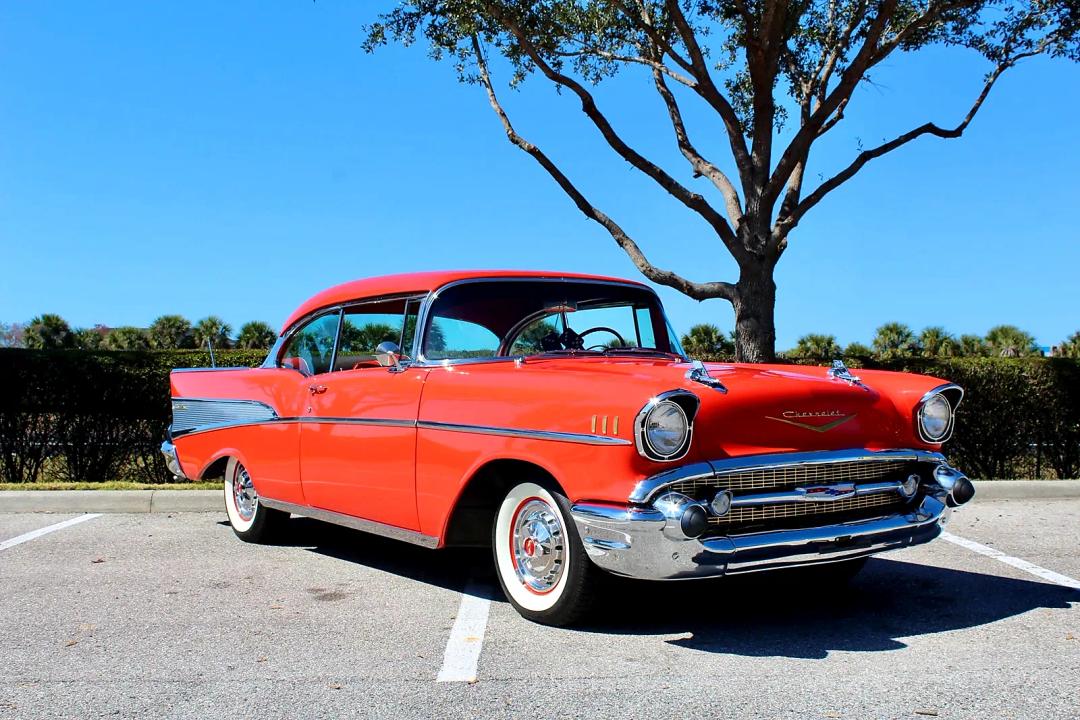
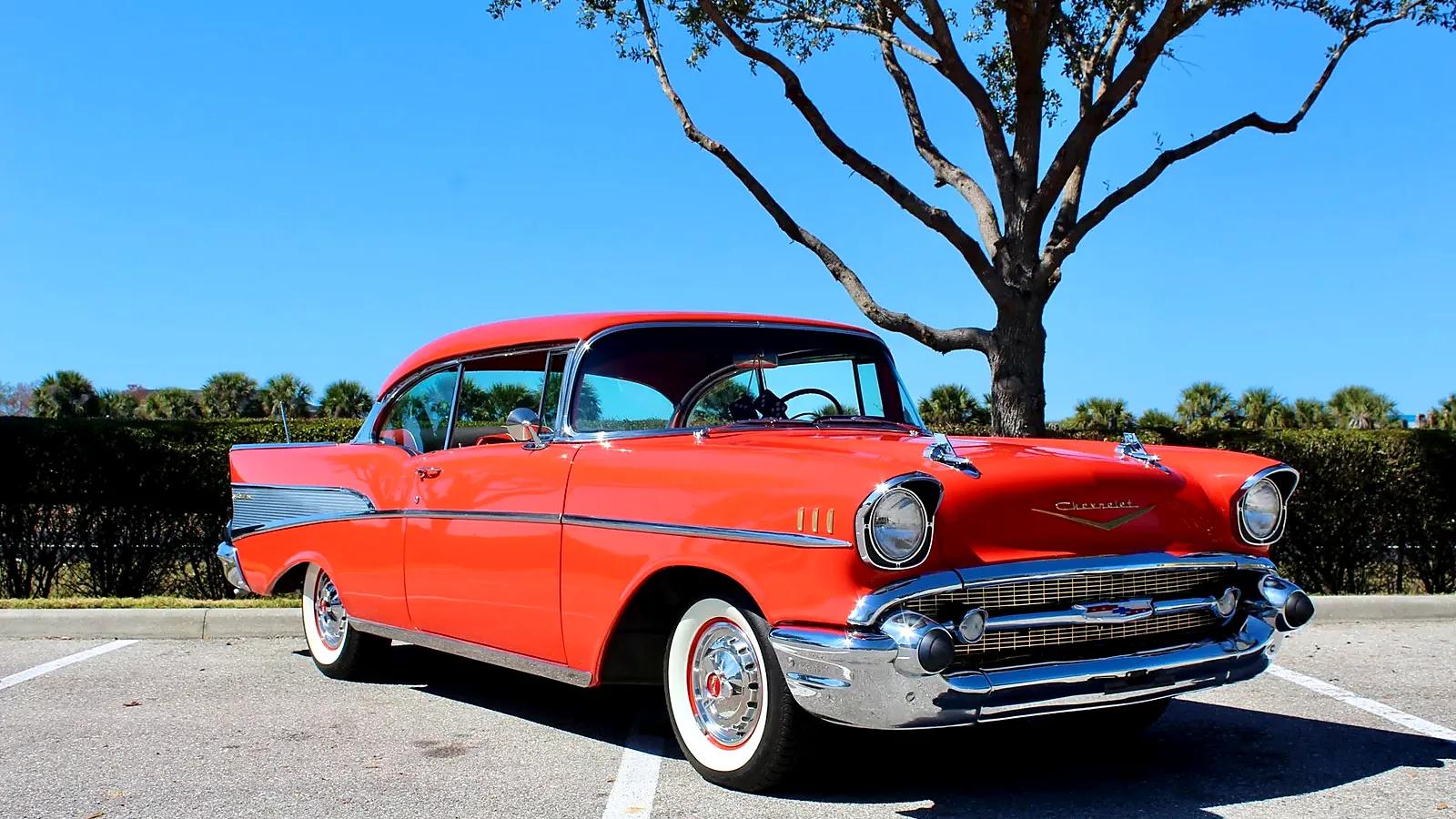
A 1957 Bel Air Sport Coupe listed with a 283 rated at 245 hp. Its VIN starts "VC57", a factory V8 Bel Air from 1957. Asking price $69,950 (as of Oct 29, 2026).
Search for a Chevy Bel Air for sale and most of what comes up is a 1955, 1956 or 1957 car, the "Tri-Five" years. The Bel Air name ran from 1950 to 1975 in the US (source 1), but these three years are the ones collectors chase. They came in sedans, hardtops, convertibles and wagons, with six-cylinder engines or the new small-block V8, and today you'll find everything from untouched survivors to big-block restomods at very different prices.
This guide covers how to tell the three years apart, what the VIN and cowl tag can and can't prove, which engines each year offered, and what we found when we read every Bel Air for sale on RareCars.com, including live asking prices. If you'd rather start with the cars, browse every Chevrolet Bel Air for sale on RareCars.com.
What to check first on any Chevy Bel Air for sale
Start with four questions, in this order:
- Which year, series and body is it? The VIN shows the year, the series (One-Fifty, Two-Ten or Bel Air) and the assembly plant. The cowl tag shows the body style (sources 2 and 4).
- Did it leave the factory with a V8 or a six? A "V" at the start of the VIN means a factory V8 (source 4).
- What engine is in it now? The engine stamping, not the VIN, tells you what the block is. The VIN doesn't identify the engine at all (sources 2, 9 and 10).
- Is it a restoration, a survivor or a restomod? All three are honest buys. They're just different purchases, and the listing should say which one it is.
1955, 1956 or 1957: how to tell the years apart
Chevrolet built about 1.8 million cars across the One-Fifty, Two-Ten and Bel Air lines in 1955 alone (source 2). The Bel Air was the top trim. From 1953 the name was used for Chevrolet's premium series rather than only for two-door hardtops (source 1). Here's how to spot each year:
| Year | Grille and front | Rear and fuel filler | Engines new that year |
|---|---|---|---|
| 1955 | "Egg-crate" grille, separate from the turn signals; smooth hood | Fuel door visible on the left rear quarter panel | Chevrolet's new small-block V8, the 265 (162 hp, 180 hp with the Power Pack) |
| 1956 | Wider grille with the turn signals set into it; smooth hood | Fuel filler hidden behind the left taillight | 265 with Powerglide rated at 170 hp; Power Pack standard on Bel Air wagons |
| 1957 | Big grille that runs down into the bumper; two "rockets" on the hood; gold anodized trim | Tall fins; fuel filler hidden in the left fin trim | 283 V8, including the 283 hp fuel-injected version; Turboglide automatic |
Sources: 1, 2 and 8. The 1955 Bel Air also paced the Indianapolis 500 that year (source 2).
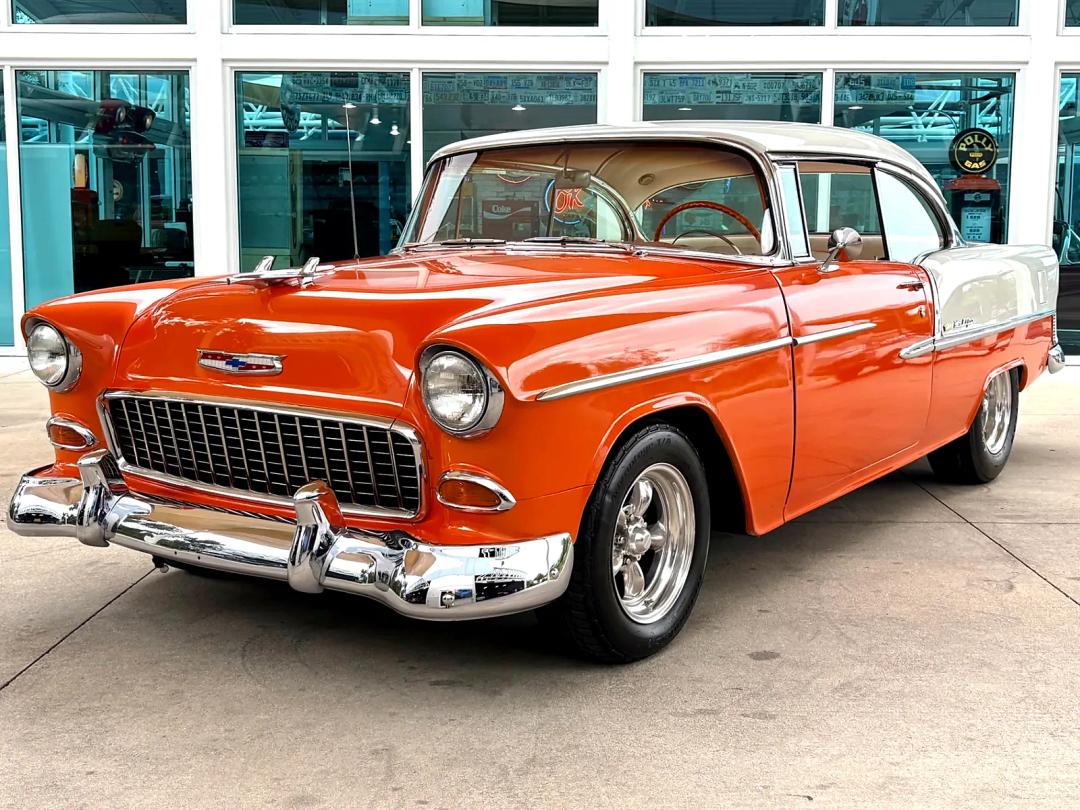
A 1955 Bel Air Sport Coupe with the one-year egg-crate grille. Its VIN starts "VC55S", a factory V8 Bel Air from the St. Louis plant, and it now runs a 350 with a 3-speed manual. Asking price $52,997 (as of Oct 29, 2026).
What the VIN tells you on a 1955–57 Chevy
The VIN plate is on the left front door hinge pillar (source 4). Tri-Five VINs are short and simple to read, but they only tell you trim and body type, model year and build plant (source 2).
How to read it
Take a VIN like VC57N114660:
- V: the car left the factory with a V8. Cars built with a six-cylinder engine have no "V" (source 4).
- C: the series. A = One-Fifty, B = Two-Ten, C = Bel Air (including the Nomad), D = Sedan Delivery (source 4).
- 57: the model year (55, 56 or 57).
- N: the assembly plant. A = Atlanta, B = Baltimore, F = Flint, J = Janesville, K = Kansas City, L = Los Angeles, N = Norwood, O = Oakland, S = St. Louis, T = Tarrytown (source 4).
- 114660: the sequence number. Each plant ran its own sequence, starting at 001001 for 1955–56 and at 100001 for 1957 (source 4).
What the VIN can't tell you
The VIN doesn't record the engine size, the transmission or the options (sources 2 and 4). A "VC" car was a factory V8 Bel Air, but the VIN won't say whether that was a 265, a 283 or a fuel-injected car. Many Tri-Fives have had fuel injection added since, and many others had theirs removed, so anything that documents whether a car should have fuel injection matters a lot (source 2).
What the cowl tag tells you
The cowl tag (also called the trim tag) is on the right side of the cowl, under the hood. Fisher Body, the coachbuilder for Chevrolet, attached it. It records the original paint color, interior color and material, and the plant (source 4).
Body style codes to know
The style number on the tag starts with the model year, then "10" for Two-Ten or Bel Air or "12" for One-Fifty, then the body (source 4):
| Code | Body |
|---|---|
| 1011 | Two-Ten and Bel Air 2-door sedan |
| 1019 | Two-Ten and Bel Air 4-door sedan |
| 1037 | Two-Ten and Bel Air 2-door hardtop (Sport Coupe on the Bel Air) |
| 1039 | Two-Ten and Bel Air 4-door hardtop |
| 1062 | Two-Ten and Bel Air 4-door wagon |
| 1064 | Bel Air Nomad 2-door wagon |
| 1067 | Bel Air 2-door convertible |
A "D" after the number marks a Bel Air, and an "F" marks a wagon, so 1062DF is a Bel Air 4-door wagon (source 4). Check that the tag agrees with the VIN: a car whose VIN says Two-Ten but which wears Bel Air trim is a Two-Ten with added trim, however nice it is.
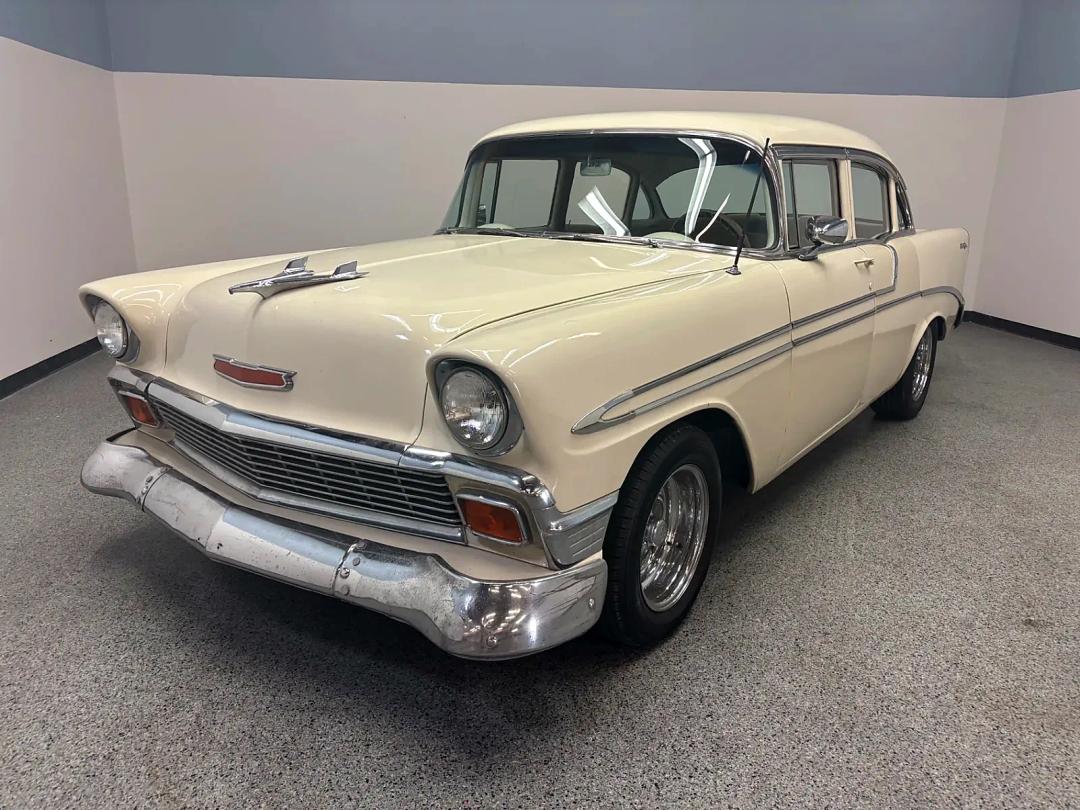
A 1956 Bel Air four-door listed as a long-stored survivor with its original Bel Air badging and Body by Fisher tag in place. Its VIN has no "V", so it left the factory as a six-cylinder car; it now has a 350 V8. Asking price $29,997 (as of Oct 29, 2026).
Bel Air engines by year
| Year | Six-cylinder | V8 options |
|---|---|---|
| 1955 | 216 six (123 hp) and 235 "Blue Flame" six (136 hp) | 265 V8: 162 hp, or 180 hp with the Power Pack (four-barrel and dual exhaust) |
| 1956 | Blue Flame 140 six | 265 V8: 170 hp with Powerglide; Power Pack versions with a four-barrel and dual exhaust |
| 1957 | Blue Flame six, still the base engine | 265 V8 at 165 hp, 283 V8 at 185, 220, 245 and 270 hp, and 283 hp with Rochester fuel injection |
Sources: 1 and 2. Production figures and some ratings differ slightly between sources, so treat a listing's horsepower claim as something to confirm on the car, not a fact on its own.
The engine stamping
On a Tri-Five V8 the engine number is stamped on a pad at the front right side of the block, behind the water pump. It starts with a plant letter (F for Flint, T for Tonawanda), then the build date, then a suffix code (source 9). The suffix ties the engine to a carburetor and transmission combination for that year: on a 1956 265, for example, "FB" means a four-barrel engine with Powerglide (source 10). Like the VIN, the stamping tells you what the block is. It doesn't prove the block is the one the car was built with, so ask what paperwork comes with the car. Factory build sheets for 1955–57 Chevys are much harder to find than for later cars (source 2).
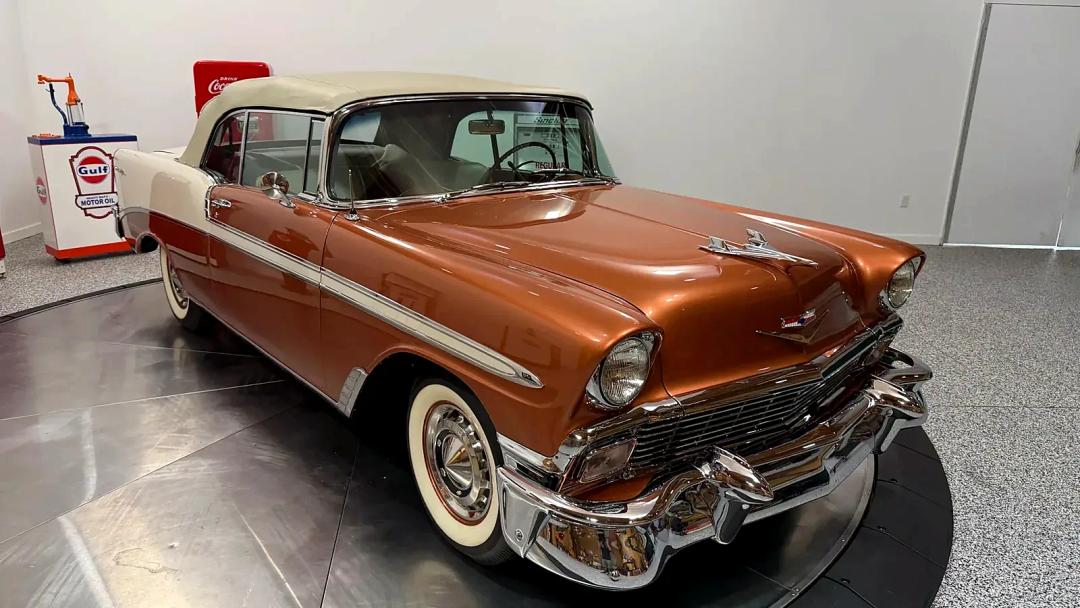
A 1956 Bel Air convertible with a 265 and Powerglide. Its listing gives the engine stamping and its "FB" suffix, the kind of detail a buyer wants to see. Asking price $125,500 (as of Oct 29, 2026).
What we found in 18 Tri-Five Bel Airs for sale on RareCars.com
On Oct 29, 2026, RareCars.com had 26 Chevrolet Bel Airs live, from a 1953 to a 1966. 18 of them are 1955–57 Tri-Five cars, and all 18 show an asking price, from $29,950 to $299,900. Half of them ask less than about $72,500. Here's what the listings show:
- The years are evenly spread. 7 are 1955s, 5 are 1956s and 6 are 1957s.
- Prices overlap across years. Live asking prices run $29,950–$139,900 for the 1955s, $29,997–$299,900 for the 1956s and $44,900–$239,900 for the 1957s. The middle price is about $55,500 for a 1955, $99,995 for a 1956 and $87,500 for a 1957, and engine and build matter more than the year.
- Two-door coupes lead. 8 are listed as coupes, 4 as sedans, 3 as convertibles and 3 as wagons (one of them a Nomad).
- A third were born as six-cylinder cars. By VIN, 9 left the factory as V8 Bel Airs ("VC") and 6 as six-cylinder Bel Airs (a "C" with no "V"). All 6 of the six-cylinder cars now run a V8. The last 3 VINs don't fit the standard Bel Air pattern as shown: one carries the Two-Ten series letter, and two are in other formats. That's a reason to read the VIN plate on any car you're serious about.
- Only 4 run a period-type engine. 2 have a 265 and 2 have a 283. The other 14 list a later small-block (327, 350 or 383), a big-block (409, 454, 496 or 502) or a modern LS7.
- The most expensive cars are built cars. The 4 highest-priced Tri-Five Bel Airs ($139,900 to $299,900) are all custom builds or restomods with big-block or modern engines. None of the 18 claims factory fuel injection.
- The cars came from all over. The 15 standard VINs come from 9 different assembly plants, from Los Angeles to Tarrytown.
- Automatics are the majority. 11 are listed with an automatic and 7 with a manual.
Beyond the Bel Air, RareCars.com also had 3 Nomads, 4 One-Fifty and 7 Two-Ten cars live. That's 32 Tri-Five Chevys in all, 29 of them priced, from $29,950 to $299,900.
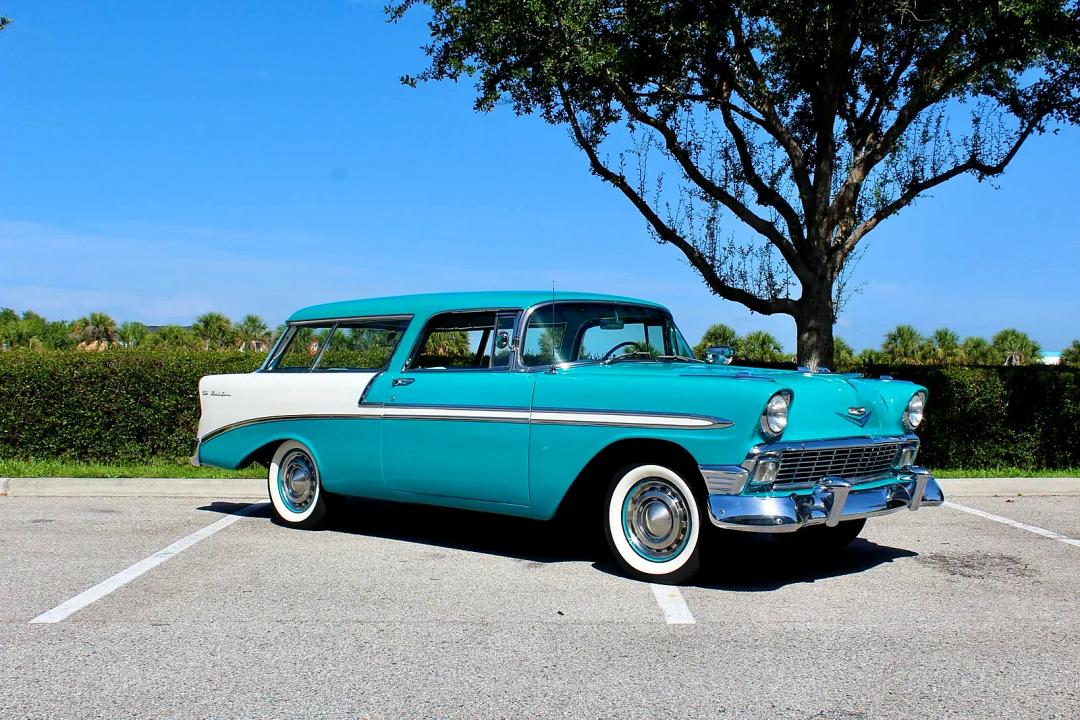
A 1956 Bel Air Nomad whose listing says it was born with a 265 V8 and has had a rebuilt 350 since 1987. That kind of plain disclosure is what you want. Asking price $74,950 (as of Oct 29, 2026).
Nomads, convertibles and the rarer bodies
The two-door Nomad wagon is the rarest Tri-Five body. GM Heritage puts 1957 Nomad production at 6,103 and the three-year total at 22,375 (source 7). Classic Industries' estimates put the Nomad lowest in each year (source 5). GM Heritage puts 1957 Bel Air convertible production at about 47,000 (source 6). A Nomad has slanted rear pillars and a tailgate with seven vertical chrome strips, and it was only built as a two-door (source 8).
Rarer bodies cost more to put right. Nomads and the 9-passenger Beauville wagons are harder to find, and some of their parts are expensive. On the Sport Coupe, the rear side-window mechanisms ("flippers") are a common problem, and the body tends to sag more than a sedan's (source 2).
Restomods and replacement engines: when they make sense
Most of the Tri-Fives for sale today aren't stock, and that's fine if the listing is honest about it. A restomod with a modern V8, overdrive automatic, air conditioning and disc brakes is a different purchase from a restored car with a 283. Judge it on the quality of the build, not on originality.
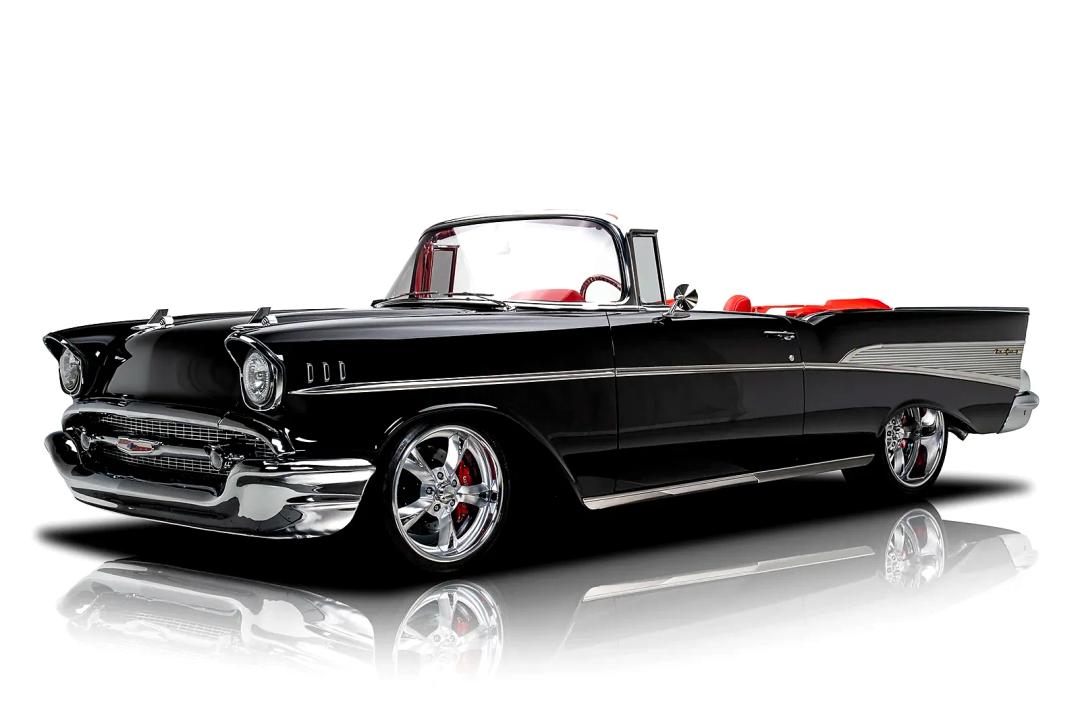
A 1957 Bel Air convertible restomod listed with a frame-off restoration, a 7.0-liter LS7 V8 and a 4-speed automatic. Asking price $239,900 (as of Oct 29, 2026).
If you want an original-style car, look for a VIN with a "V" if you want a factory V8, a period-correct 265 or 283 with a stamping that fits the year, and paperwork. If you're buying a car to modify, the body and frame matter most: paint and bodywork are usually the biggest cost (source 2).
A pre-purchase checklist for a Chevy Bel Air for sale
- Read the VIN plate on the left front door hinge pillar and decode the year, series, plant and V8 code.
- Check that the cowl tag body code matches the VIN and the car (a 1064 should be a Nomad, a 1067 a convertible).
- Note whether the VIN has a "V". If it doesn't, the car started as a six, whatever is in it now.
- Find the engine stamping on the front right of the block and ask what the suffix code means for that car.
- If a car is sold as factory fuel-injected, ask for documentation. Fuel injection was often added later (source 2).
- Check for rust in the frame, body mounts, door bottoms, fender bottoms, rockers, the passenger-side floor and the trunk floor (source 2).
- On a Sport Coupe, check the rear quarter windows and the door gaps for body sag (source 2).
- On a Nomad or Beauville, price the wagon-only trim and glass before you commit (source 2).
- Ask for the paperwork: receipts, restoration photos and any original documents.
- Get an independent inspection by a Tri-Five specialist before you pay.
Chevy Bel Airs for sale on RareCars.com
As of Oct 29, 2026, RareCars.com has 26 Chevrolet Bel Airs listed by dealers across the US, including 18 Tri-Five cars from 1955 to 1957. They range from a six-cylinder-born four-door survivor to a 265 convertible and supercharged big-block builds. Live asking prices on the 25 Bel Airs with listed prices run from $21,500 to $299,900 (1 listing shows no price). Every listing is reviewed and approved, and you contact the listing dealer through RareCars.com to check availability. Cars sell, so if a car linked here is gone, see the Bel Airs for sale now.
More to explore:
1. All Chevrolet Bel Airs for sale, from 1953 to 1966
2. Chevrolet Nomads for sale
3. Chevrolet One-Fifty and Two-Ten listings, the Bel Air's Tri-Five siblings
4. Chevrolet Impalas for sale, the model that took over at the top of the range
5. C1 Corvettes for sale, the Bel Air's 1950s stablemate
6. All Chevrolets on RareCars.com
7. Pontiac GTO for sale: buyer's guide
8. Rare American cars of the 1960s
9. Classic car dealers near you
10. Selling a Bel Air? List it on RareCars.com, or read where to sell a classic car online
FAQ
What years is the Chevy Bel Air "Tri-Five"?
1955, 1956 and 1957. "Tri-Five" covers the One-Fifty, Two-Ten and Bel Air from those three years (sources 2 and 4).
How can I tell a 1955, 1956 and 1957 Bel Air apart?
The 1955 has an egg-crate grille separate from the turn signals and a visible fuel door on the left quarter. The 1956 has the turn signals in a wider grille and the fuel filler behind the left taillight. The 1957 has a grille that runs into the bumper, hood "rockets," tall fins and gold anodized trim (sources 2 and 8).
Does the VIN tell me the original engine?
No. It tells you whether the car was a factory V8 (a "V" at the start) or a six, plus the series, year and plant. It doesn't say which V8 or which transmission (sources 2 and 4).
Where is the VIN on a 1955–57 Chevy?
On a plate on the left front door hinge pillar. The cowl tag is on the right side of the cowl under the hood (source 4).
How many 1957 Chevy Nomads were built?
GM Heritage gives 6,103 for 1957 and 22,375 for 1955–57 (source 7). Some other sources give slightly different figures.
How much is a Chevy Bel Air for sale today?
On Oct 29, 2026, the 18 Tri-Five Bel Airs live on RareCars.com asked from $29,950 to $299,900, and half asked less than about $72,500. Prices depend more on engine, body and build than on year. These are asking prices, not sale prices.
Is a six-cylinder Bel Air with a V8 swap worth less?
It depends on what you want. Of the 18 Tri-Five Bel Airs on RareCars.com today, 6 started as six-cylinder cars and all now have V8s. For a driver or restomod that may not matter. For an original-style car, a factory V8 VIN matters more.
Sources
- Wikipedia, "Chevrolet Bel Air" (1950–1975 US model years; Bel Air as a two-door hardtop name 1950–52 and a premium series from 1953; Tri-Five six-cylinder, 265 and 283 engines; 1957 fuel-injected 283 at 283 hp), read Oct 29, 2026: https://en.wikipedia.org/wiki/Chevrolet_Bel_Air
- Hagerty, "Your handy 1955–57 (Tri-Five) Chevrolet buyer's guide" (1.8 million cars in 1955; 1955 Indy 500 pace car; 162/180 hp 1955 V8; 1956 grille, turn signals, fuel filler, 170 hp with Powerglide, Power Pack standard on Bel Air wagons; 1957 gold anodized trim, 283 and fuel injection at 283 hp, Turboglide; VIN shows only trim, body, year and plant; build sheets rare; fuel injection added and removed; rust areas; Nomad and Beauville parts; coupe window and body sag; paint and bodywork cost), read Oct 29, 2026 (curl of the public page): https://www.hagerty.com/media/buying-and-selling/your-handy-1955-57-tri-five-chevrolet-buyers-guide/
- Hagerty, "How the 1955–57 'Tri-Five' Chevy became a midcentury masterpiece" (background, 1955 Indy 500 pace car), read Oct 29, 2026: https://www.hagerty.com/media/automotive-history/how-the-1955-57-chevy-became-a-midcentury-masterpiece/
- Classic Industries, "1955-57 Chevy VIN Decoder & Trim Tag Decoder" (VIN plate location, V8 code, series letters, plant codes, sequence starts, cowl tag location and contents, body style codes, D and F suffixes), read Oct 29, 2026: https://news.classicindustries.com/1955-57-chevy-vin-decoder
- Classic Industries, "1955-57 Chevy Bel Air, 210, and 150 Production Numbers" (production by body; the source labels its figures as estimates), read Oct 29, 2026: https://news.classicindustries.com/1955-57-chevy-production-numbers
- GM Heritage Collection, 1957 Chevrolet Bel Air Convertible (about 47,000 built in 1957), read Oct 29, 2026: https://www.gm.com/heritage/collection/chevrolet/1957-chevrolet-bel-air-convertible
- GM Heritage Collection, 1957 Chevrolet Nomad (6,103 built for 1957; 22,375 over three years), read Oct 29, 2026 (WebFetch): https://www.gm.com/heritage/collection/chevrolet/1957-chevrolet-nomad
- Champion Cooling Systems, "Spotter's Guide: Identifying The 1955-1957 Chevy" (grille, hood, tail lamp and fuel filler differences by year; Nomad pillars and tailgate), read Oct 29, 2026: https://blog.championcooling.com/2021/03/25/spotters-guide-identifying-the-1955-1957-chevy/
- Old Car Manual Project, "1941 - 1957 Chevrolet Engine Identification" (V8 engine number pad on the front right of the block behind the water pump; F = Flint, T = Tonawanda; suffix codes), read Oct 29, 2026: https://chevy.oldcarmanualproject.com/models/engine.htm
- TriFiveWorld, engine suffix decoder (1956 "FB" = 265, Powerglide, four-barrel), read Oct 29, 2026: https://macswebs.com/trifiveworld/scripts/decode/engine.html
- RareCars.com listing pages for all 26 Chevrolet Bel Air, 3 Nomad, 4 One-Fifty and 7 Two-Ten listings (from https://rarecars.com/sitemap.xml; JSON-LD price, VIN and images plus the description), read Oct 29, 2026, ~9:05 AM PT. Data:
evidence/post5-bel-air-2026-10-29/listings-2026-10-29.csv. - Google Keyword Planner Historical Metrics export 2026-10-28 (US; Oct 1, 2025 – Sep 30, 2026): "chevy bel air for sale" = 1K–10K avg monthly searches, Competition Medium. File:
seo/keyword-plan-top30-2026-10-28-gkp.md.
TEAM-COPY-RULES self-check (not for publishing)
- "RareCars.com" written correctly everywhere: PASS.
- No personal names in the post: PASS. The specialist quoted in source 2 and the author of source 8 are not named; dealer staff and builders named in listings are not used.
- No Bring a Trailer, Fantasy Junction or Classic Cars West, as names, sources or photos: PASS. Hemmings (a listing competitor) is not cited either.
- No location wording (no Campbell or Bay Area): PASS. Dealer cities are not used. Factory plant names (e.g. Los Angeles, Tarrytown) are 1950s Chevrolet plants, not our location.
- No listing-duration, commission or RareCars.com pricing or policy claims: PASS. Car prices are live listing asking prices only, dated Oct 29, 2026. No dollar figure for the 1 unpriced Bel Air.
- Buyer contact is "through RareCars.com", never "directly": PASS.
- "Reviewed and approved" wording is the Ramil-approved line used in posts 2–4: PASS.
- No "inventory sync" claims: PASS.
- Photos are dealer listing images, credited "Photo:
" and linked to the listing (M-PHOTO). No overlay watermark or readable plate; the 7 watermarked covers and 1 low-res cover were excluded; each photo has a target size and destination per IMAGE-SIZE-SPEC.md: PASS. Designer QA is pending. - Lists numbered: PASS. Tables are used for data.
- No investment or value claims, and nothing about a specific car's authenticity beyond what its listing states: PASS. The 3 odd VINs are described as a group, with no listing named.
- Dealer names appear only in photo credits (per M-PHOTO), not in body copy: PASS.
- FOCUS-W44 (no new ideas or features): PASS. Same format as posts 1–4, and schema stays parked.
- Google range used for the primary keyword, with no Ahrefs-only monthly numbers: PASS (Ahrefs KD appears only in these notes).
- Every fact has a numbered source read Oct 29, 2026, with specialist sources beyond Wikipedia: PASS.
Open items
- Cofounder content review and Designer photo QA (6 photos; hero and share crops needed).
- Publishing waits on Ramil's OK (CTO publishes; Marketer never publishes).
- Not verified today: the San Jose Classic Chevys VIN decoder page that Hagerty points to (old sanjosechevys.org URL returned errors; the club's current site is sjclassicchevy.com). Not cited.
- Horsepower ratings differ slightly between engine-code tables online. The post uses Hagerty and Wikipedia ratings and gives only one suffix example (FB), which matches both source 10 and the listing's own description.
- Data notes for CTO (parked; "Only you", so not asked this week): 3 Tri-Five Bel Air listings show VINs that don't fit the standard Bel Air format (#1000000870 "VB55…", #1000000903 "5N07797", #1000000402 "AZ398557"). Dealer data, not changed.
- When posts 3 and 4 are live, add "More to explore" links to
/blog/chevelle-for-sale-buyers-guideand/blog/c2-corvette-for-sale-buyers-guide.
Ready to sell? Compare Private Sale, Dealer Sale and Fast Cash Offer.
Sell your car →